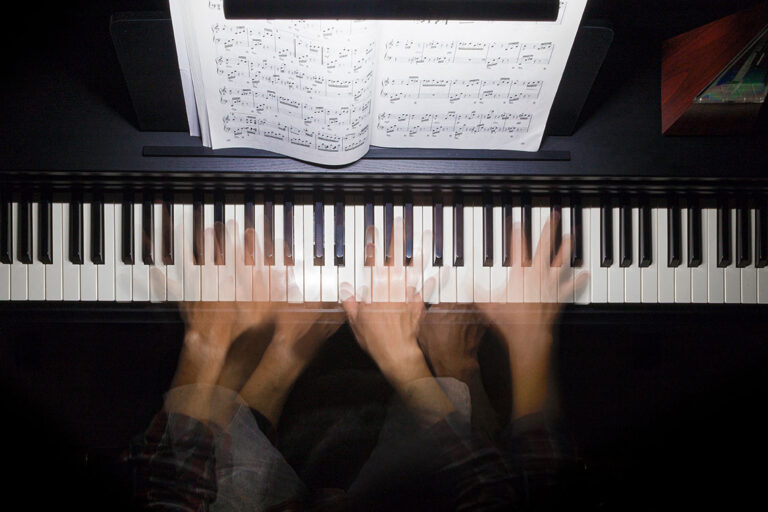

Interpreting classical piano music demands more than technical mastery—it requires a thoughtful dialogue between the composer’s intentions and the performer’s artistic voice. For intermediate to advanced pianists, the challenge lies in balancing historical fidelity with personal expression. Here’s a refined approach to cultivating depth and subtlety in your performances.
1. Contextualize the Composition
Begin by situating the work within its historical and biographical framework. A Scarlatti sonata, rooted in Baroque ornamentation, demands a different sensibility than a Brahms intermezzo, which thrives on Romantic introspection.
- Research the era: Understand stylistic conventions. For example, Classical-era works (Mozart, Haydn) prioritize clarity and structure, while Late Romantic pieces (Rachmaninoff, Mahler) embrace rubato and textural complexity.
- Study the composer’s intent: Letters, diaries, and contemporaneous accounts offer insights. For instance, Schumann’s Kinderszenen reflects his dual identity as composer and critic, blending childlike simplicity with underlying sophistication.
- Analyze the score: Treat expressive markings (espressivo, sotto voce) as directives, not suggestions. A calando (gradually softer and slower) in a Chopin ballade might signify emotional retreat rather than mere decrescendo.
2. Refine Your Technical Palette
Advanced interpretation hinges on precise control of touch, dynamics, and articulation. Consider these elements as tools to shape phrasing:
- Articulation: Differentiate between non-legato (Bach’s contrapuntal lines) and legatissimo (Liszt’s lyrical melodies).
- Dynamic layering: Highlight inner voices in a Beethoven sonata by subtly emphasizing the tenor line, or thin the texture in a Debussy prelude to evoke mist.
- Pedaling: Use half-pedaling for Baroque transparency, or employ flutter pedaling in Impressionist works to blur harmonies without muddiness.
Practice strategy: Isolate passages to experiment with varying articulations. Play a Bach invention with detached touch, then rework it legato—note how the character shifts.
3. Cultivate Artistic Independence
While respecting the score, allow room for informed individuality. This is where advanced pianists distinguish themselves:
- Phrasing: Avoid mechanical repetition. In a Schubert impromptu, shape each recurrence of the theme with slight dynamic or agogic variations.
- Tempo flexibility: Use rubato judiciously. In a Mozart concerto, a discreet ritardando before a cadence can heighten anticipation without distorting Classical proportions.
- Coloristic contrasts: Explore timbral shifts. For example, voice the left-hand octaves in a Prokofiev toccata with a sharper attack to underscore its motoric drive.
Example: Compare recordings of Ravel’s Jeux d’eau by Arturo Benedetti Michelangeli (crystalline precision) versus Bertrand Chamayou (fluid impressionism). Both are valid, yet distinct.
4. Engage in Critical Listening
Deepen your interpretative lens by studying recordings and live performances:
- Compare interpretations: Analyze how András Schiff (structured, intellectual) and Radu Lupu (introspective, spontaneous) approach the same Schubert sonata.
- Attend to architecture: Note how pianists like Grigory Sokolov build long-form tension in a Beethoven fugue through dynamic pacing.
- Avoid mimicry: Use these observations to refine—not replicate—your own vision.
5. Embrace the Role of the Performer-Scholar
For advanced pianists, interpretation is an ongoing scholarly pursuit:
- Study primary sources: Examine Urtext editions to minimize editorial interference. A slur in a Chopin manuscript might differ from popular editions.
- Explore period instruments: If possible, play on a fortepiano to grasp the tactile nuances Mozart or Beethoven expected.
- Collaborate with peers: Discuss interpretative choices in masterclasses or forums. A colleague’s perspective on a Debussy arabesque might reveal overlooked nuances.
Final Insight: Interpretation as Evolution
There is no definitive interpretation—only evolving ones. Your relationship with a piece will mature as your technical and intellectual horizons expand. Revisit works annually; a Bach partita you played at 20 may resonate differently at 40.
Approach each performance as a conversation: one where the composer’s voice, your artistry, and the listener’s perception intersect.
About Anna Robinson: Anna Robinson is an experienced pianist and pedagogue specializing in classical repertoire. With certifications from ABRSM, her work emphasizes the synthesis of technical rigor and interpretative depth.
For further study, explore the annotated scores of Alfred Brendel or the masterclasses of Murray Perahia.
Note: This guide draws from methodologies endorsed by the Royal Conservatory of Music and insights from pianists including Richard Goode and Maria João Pires.